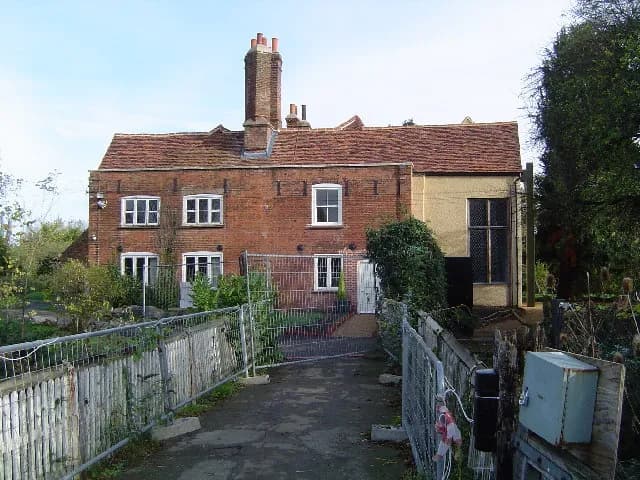
Tucked away in Headstone Recreation Ground stands the oldest timber-framed building in Middlesex, a Grade I listed medieval manor that traces its origins to the early 14th century. Headstone Manor is the earliest surviving domestic structure in the historic county, built around 1310 according to dendrochronological dating of its oldest timbers.
A Moated Residence for Archbishops
The site has attracted settlement for well over a millennium. Evidence of occupation stretches back to the Roman period, while written records show the land belonged to Wulfred, Archbishop of Canterbury, as early as 822 AD. The present manor house rose in 1310, and in 1344 Archbishop John de Stratford acquired additional land, establishing the site as his principal Middlesex residence.
The property remained in archiepiscopal hands until 1546, when it was surrendered to Henry VIII during the Dissolution. The king promptly sold it to Edward North, 1st Baron North, beginning nearly four centuries of private ownership, primarily by tenant farmers. The London Borough of Harrow acquired the estate in 1925, and it has remained in public ownership ever since.
Architectural Layers Across Six Centuries
What makes Headstone Manor architecturally significant is its visible chronology of English domestic building. At its heart lies a rare 14th-century timber-framed aisled hall. The Great Hall received oak panelling in 1631, and a brick façade was added during the 1770s, giving the building its present external appearance.
The manor sits within a water-filled moat accessed by a bridge; this is believed to be the only surviving intact moat in Middlesex. Historians note the moat served principally as a status symbol rather than for defence, reflecting the wealth of its medieval occupants.
The Great Barn and Outbuildings
The manor is flanked by three additional listed structures. The Great Barn, or Tithe Barn, was constructed in 1506 on the orders of the Archbishop of Canterbury. Measuring 43 metres long and 9 metres high, its framework is built entirely from English oak. The building was restored during the 1970s and converted for museum use; it now serves as a function space following refurbishment in 2014.
The Small Barn stands on 14th-century foundations and carries Grade II listing. It suffered severe fire damage in the mid-1970s and remained under a protective canopy for two decades before reopening in autumn 2017. The 18th-century Granary, also Grade II listed, was moved to the site from Pinner Park Farm in 1991 and reopened as a learning space following Heritage Lottery Fund restoration.
Harrow Museum and Collections
Harrow Museum was established at the site in 1986 and holds more than 15,000 objects connected to the local area. The collections preserve Harrow's industrial heritage, including material from the Eastman Kodak factory, Whitefriars Glass factory, and Hamilton paint factory. Archaeological holdings range from prehistory to the recent past.
The entire moated site carries scheduled monument status, designated on 5 December 1986. All four buildings on the property are individually listed, creating what architectural historians have described as one of the most interesting domestic complexes in the country.
The Park and Visitor Facilities
Headstone Manor Park spans more than 50 acres and was awarded Green Flag status in 2025. The grounds underwent comprehensive restoration in 2021, including the creation of a new wetland area. Facilities include sports pitches, tennis courts, a playground, and a coffee shop.
The Moat Café and Visitor Centre operates daily except Mondays, serving refreshments and housing a gift shop. A free car park on Pinner View lies 100 metres from the entrance. The site is served by Headstone Lane railway station on the Overground network, and by bus routes H9, H10, H14, H18, H19, and 223.