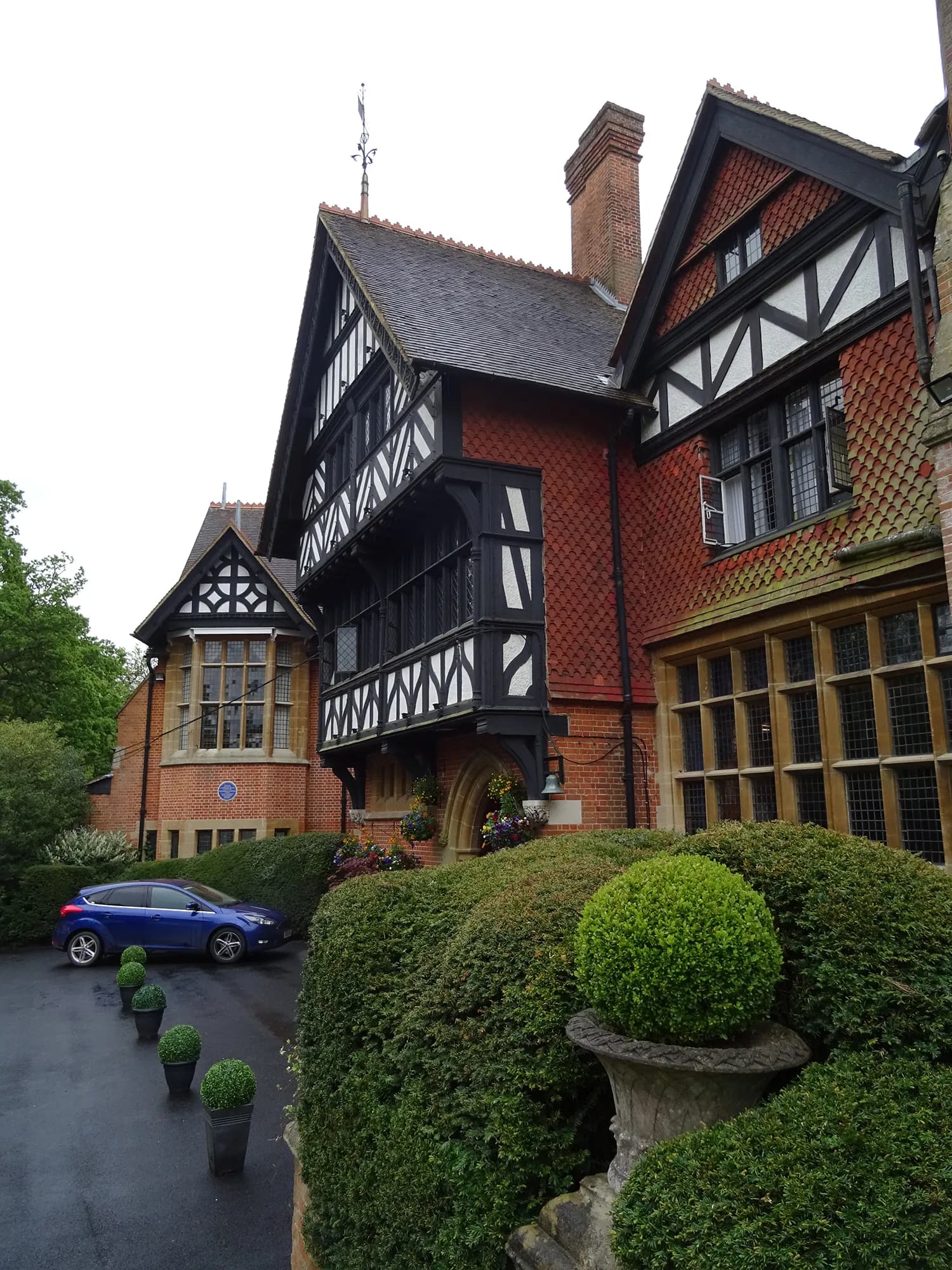
A Harrow Haven for the Savoyard Dramatist
In August 1890, William Schwenck Gilbert purchased a substantial country house on the edge of Harrow Weald for £4,000. The property, Grim's Dyke, would become both his sanctuary and his final resting place, anchoring one of Victorian Britain's most celebrated literary figures firmly within the London Borough of Harrow.
The House and Its History
Grim's Dyke was built between 1870 and 1872 by the eminent architect Richard Norman Shaw for the Victorian painter Frederick Goodall. The house stands on Old Redding in Harrow Weald, taking its name from the nearby Grim's Ditch, a prehistoric earthwork stretching some six miles from Pinner Hill to Bentley Priory. Archaeologists believe this ancient defensive work was constructed around 50 AD by the Catuvellauni tribe as protection against Roman incursion.
Gilbert immediately set about making the property his own. He installed an elaborate fireplace of Cornish alabaster in what had been Goodall's studio, converting it into his drawing and music room. The stable block became garages to house his growing collection of motorcars. He established a home farm stocked with Jersey cattle, horses, pigs, and fowl, alongside a vinery, apiary, and orchards. Exotic animals roamed the grounds, including monkeys, lemurs, and a lynx. His wife, Lady Gilbert, designed some 30 acres of ornamental gardens that remain a feature of the property today.
Creative Work in the Library
From an armchair in his library overlooking the croquet lawn, Gilbert wrote his final ten works during his two decades at Grim's Dyke. These included Utopia Limited (1893) and The Grand Duke (1896), his last collaborations with Sir Arthur Sullivan. Sullivan himself visited Grim's Dyke on 27 May 1893, spending three days there to finalise Utopia Limited. Gilbert received his knighthood in 1907, becoming Sir William Schwenck Gilbert, and continued working from his Harrow retreat until the very end of his life.
The Lake and Its Tragedy
In 1899, Gilbert began digging a lake on the grounds, working on the task himself alongside labourers. The lake eventually covered approximately 1.5 acres, with an island at its centre. By 1905, it had been extended to a rectangular shape measuring 170 yards by 50 yards. Gilbert swam there daily from March to September each year, draining and refilling the water annually to keep it clear, and stocking it with trout.
On 29 May 1911, Gilbert had arranged to give a swimming lesson to two local women: Winifred Isabel Emery, a teacher and niece of actors Cyril Maude and Winifred Emery, and her 17-year-old pupil Ruby Vivian Preece. The party arrived at the lake at approximately 4 pm.
According to Winifred Emery's eyewitness account, recorded in 1923: "Sir William Gilbert was teaching me to swim, and he invited me and a pupil of mine to Grim's Dyke on May 29th. We met him at Harrow Station and motored to Grim's Dyke and went straight to the bathing pool... presently she shrieked out 'Oh, Miss Emery, I am drowning!' I called Sir William, who was on the steps, and he called out to her not to be frightened, and that he was coming. He swam out to her very quickly, and I heard him say: 'Put your hands on my shoulder and don't struggle.' This she did, but almost immediately she called out that he had sunk under her and had not come up."
The Coroner's Verdict
Ruby Preece later testified at the inquest: "I found that I could not stand and called out and Sir William swam to me. I put my hand on his shoulder and I felt him suddenly sink." The family doctor, W.W. Shackleton, and another medical man, Daniel Wilson, certified that Gilbert had died instantly of heart failure at approximately 4:20 pm. The official cause was syncope brought on by excessive exertion.
Two days later, on 31 May 1911, a coroner's jury convened in the billiard room at Grim's Dyke to record a verdict of accidental death. Gilbert's body was laid out in that same room, which now serves as the hotel's restaurant.
Legacy in Harrow
Lady Gilbert and the couple's ward, Nancy McIntosh, continued to live at Grim's Dyke until Lady Gilbert's death in 1936. Shortly after her husband's drowning, Lady Gilbert had the lake closed off and largely drained. The property's contents were sold at auction in March 1937 for £4,600.
Grim's Dyke subsequently served as a rehabilitation centre under the North West Regional Hospital Board from 1937 to 1962, before its conversion into the Grim's Dyke Hotel in 1970. Harrow Council owns the building and the remaining 30 acres, leasing the property to the hotel operator.
Today, Grim's Dyke stands as a Grade II* listed building and appears on the National Register of Historic Parks and Gardens. The Harrow Heritage Trust has erected a plaque at the entrance commemorating Gilbert's residence and the circumstances of his death. Grim's Dyke Opera regularly performs Gilbert and Sullivan works at the venue, maintaining the connection between this Harrow landmark and its most famous resident. In 2011, the discovery of Great Crested Newts near the lake ponds prompted conservation efforts, adding another chapter to the property's long history.
